 |
Cathar Castles
|
   |
 |
|
|
|
|
|
||||||||||||||||||||||||||||||||||||||||||||||||||||||||||||||||||||||||||||||||||||||||||||||||||||||||||||||||||||||||||||||||||||||
|
|
|
|
|
|
 |
||||||||||||||||||||||||||||||||||||||||||||||||||||||||||||||||||||||||||||||||||||||||||||||||||||||||||||||||||||||||||||||||||||||
|
|
Château Comtal de Carcassonne
|
||||||||||||||||||||||||||||||||||||||||||||||||||||||||||||||||||||||||||||||||||||||||||||||||||||||||||||||||||||||||||||||||||||||||||


 |
Carcassonne was besieged from 1st to 15th of August 1209 during the early phase of the War against the Cathars of the Languedoc. The siege followed soon after the Crusaders' massacre of the entire population of Béziers, an act of terror designed to terrify the people of the area. Raymond-Roger Trencavel was Viscount of Béziers as well as Carcassonne - his cities were deliberately targeted by the Crusaders, as the Count of Toulouse had joined the Crusade himself, gaining immunity for his own lands.
See sepate sections below on:
|
The Château Comtal - entrance from the Cité |
 |
|
The Château Comtal - the Aude Gate |
 |
|
|
Address
Contact
James McDonald
Tel from the US: 010 33 468 201142
Tel from the UK: 01 33 468 201142
Tel from France: 0468 201142
Tel other: + 33 468 201142
e-mail castlesandmanorhouses@gmail.com
Google Maps
|
Small scale map showing the location of |
|
Google map showing the location of |
|
Large scale map showing |
Location
The Cité of Carcassonne lies on a hill in the modern city of Carcassonne, on the opposite side of the river from the Ville Basse.
Like many major medieval towns, it sits on the site of an ancient oppidum, overlooking a river near a fording point, and on a trade crossroads.

History
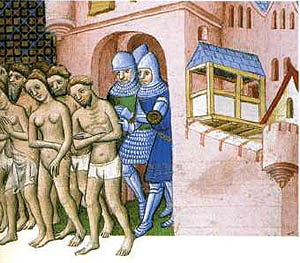
Raymond-Roger came out to parley with the Crusaders, then under the command of the Abbott-Comander Arnaud Amaury. He was offered the opportunity to leave the city with a few of his senior nobles, but declined the offer. What the author of the Song of the Cathar Wars conceals in his narrative is that the city and its castle were taken by deceit, when Raymond-Roger came out to parley. Scandalously, the Viscount was seized and taken prisoner. Without his leadership, resistance crumbled and the city surrendered.
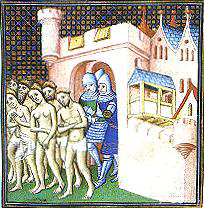 The
Crusaders expelled the inhabitants with a day's safe conduct, so
that God's army could loot at leisure. Their lesson from Béziers
had been that massacres risked the total destruction of the city,
including the loss of all loot by fire. Arnaud wrote to the pope,
Innocent
III, to explain why on this occasion no-one had been killed.
It is at this stage that Simon
de Montfort was appointed to hold Raymond-Roger's territories.
The
Crusaders expelled the inhabitants with a day's safe conduct, so
that God's army could loot at leisure. Their lesson from Béziers
had been that massacres risked the total destruction of the city,
including the loss of all loot by fire. Arnaud wrote to the pope,
Innocent
III, to explain why on this occasion no-one had been killed.
It is at this stage that Simon
de Montfort was appointed to hold Raymond-Roger's territories.
Soon afterwards, on the 10th November, Roger-Raymond died in mysterious circumstances in his own prison. He had reigned for fifteen years and was aged just 24 at the time of his death in the custody of the French Catholic Crusaders. According to a rumour current at the time (mentioned in the contemporary Song of the Cathar Wars, laisse 37) he was murdered during the night. Later, the pope himself referred to the disgraceful killing of the Viscount in letter that still survives. Do not expect to hear about this, or anything else about the period, if you take the guided tour.

 When
Raymond-Roger
died he left a young son, now the rightful Viscount of Béziers
and Carcassonne,
but dispossessed of his inheritance by Simon
de Montfort who took the Trencavel
titles contrary to all feudal law but with the blessing of the Catholic
Church. The son, Raymond
Trencavel II, took refuge with his kin, the Count
of Foix, and his suzerain, the King
of Aragon. Years later, in 1240, Raymond
II attempted to regain his patrimony by force of arms, and almost
succeeded in taking Carcassonne.
After his failure he broke his seal as a token to his submission
to the King of France, releasing his vassals from their allegiance,
and the great The
House of Trencavel disappeared from history.
When
Raymond-Roger
died he left a young son, now the rightful Viscount of Béziers
and Carcassonne,
but dispossessed of his inheritance by Simon
de Montfort who took the Trencavel
titles contrary to all feudal law but with the blessing of the Catholic
Church. The son, Raymond
Trencavel II, took refuge with his kin, the Count
of Foix, and his suzerain, the King
of Aragon. Years later, in 1240, Raymond
II attempted to regain his patrimony by force of arms, and almost
succeeded in taking Carcassonne.
After his failure he broke his seal as a token to his submission
to the King of France, releasing his vassals from their allegiance,
and the great The
House of Trencavel disappeared from history.
 Ramparts.
The Cité's outer ramparts, complete with turrets, towers,
and crenellations, were built during the reign of Louis IX. His
son, Philip III, continued the work. He also added a
main gate, called the Porte Narbonnaise, to the inner walls. The
Porte is the only entry into the Cité by road. It
is guarded by two flanking towers and a double barbican.
Ramparts.
The Cité's outer ramparts, complete with turrets, towers,
and crenellations, were built during the reign of Louis IX. His
son, Philip III, continued the work. He also added a
main gate, called the Porte Narbonnaise, to the inner walls. The
Porte is the only entry into the Cité by road. It
is guarded by two flanking towers and a double barbican.
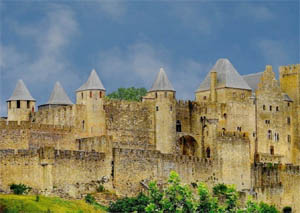
Château Comtal. 12th century castle belong to the Viscounts. It is located within the Cité's ramparts. Its fortifications are among Europe's finest medieval remains. You can take a guided tour, but don't expect too much by way of historical expertise.
Click here for more about the Cité
of Carcassonne 
Click on the following link to visit a Carcassonne
Photo Gallery
After the initial attacks of the Crusaders, the Roman Catholic Church soon recognised the need for a way to keep the local population subjugated and compliant. The solution was the Inquisition - the first papal Inquisition in Europe - largely manned by the new Dominican Order, founded by Dominic Guzman. Though Inquisitors travelled extensively, they were based in major power centres like Carcassonne. You can still see their headquarters in Carcassonne and a tower they used.
For accused first offender "heretics" willing to repent the penalty was not death, at least not a formal sentence of death. Inquisitors had a range of punishments, including close imprisonment on a diet of bread and water which generally killed people within a few months. Occasionally people might survive for a year or two, despite the poor diet, lack of heat and light, and lack of any hygiene or medical facilities. To create enough prison space Inquisitors at Carcassonne would wall up their victims - a punishment known as strict immuration.
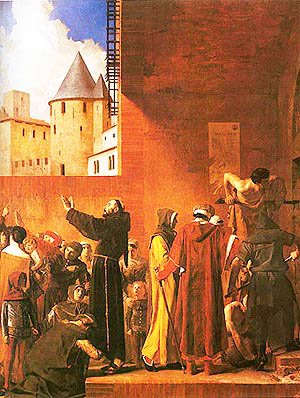
The only Catholic Churchman generally recognised outside the Church as having acquitted himself with honour during the whole period of Cathar repression was a Franciscan friar called Bernard Delicieux. He is shown here on the right releasing prisoners who had been condemned by Inquisitors to imurration. Delicieux was eventually charged with treason by his Dominican enemies and himself condemned to the wall where, predictably, he died under the harsh conditions.
Two, more fortunate, victims in the early fourteenth century were a Catholic priest named Barthélemy Amilhac and his wife Béatrice de Planissolles, sometime chatelaine of Montaillou. They were sentenced to the wall in perpetuity but survived for more than a year and were released. They had been questioned by Jacques Fournier, Bishop of Pamiers sitting with Inquisitors from Carcassonne. Click on the following links to read English transcripts of the interrogation of Barthélemy Amilhac and Béatrice de Planissolles.
|
|
|
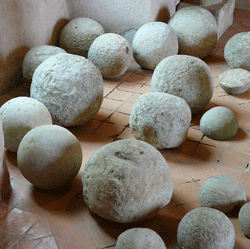
Perrier Stones at Carcassonne |
 |
|
|
|
Carcassonne |
 |
|
|
|
Perrier Stones at Carcassonne |
 |
 |
|
|
|
The Release of Prisoners at Carcassonne |
 |
Here is a description from the contemporary Song of the Cathar Wars , laisse 15, written in Occitan, by a poet sympathetic to the crusader cause. He recognises Raymond-Roger's nobility but carefully skates over what happened to him.:
|
Lo vescoms de Bezers no fina noit ni jorn |
[Raymond Roger] the Viscount of Béziers
worked day and night |
Architecture
|
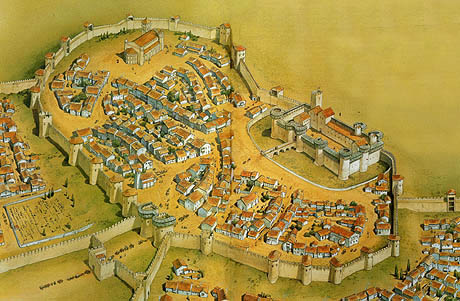
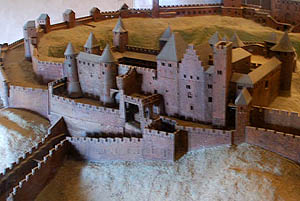
Imagined view of the Cité of Carcassonne before the Cathar Wars |
 |
|
Drawing of the Château Comtal before the Cathar Wars |
 |
|
|
Photographs
|
Residents being expelled from Carcassonne in 1209 |
 |
 |
|
Carcassonne Corbel |
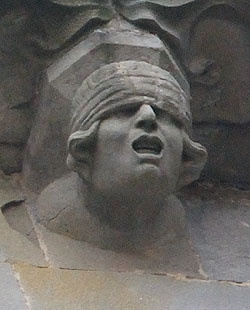 |
|
Carcassonne Corbel |
 |
|
View of the Château Comtal with barbicans on both sides |
 |
|
View of the Château Comtal from the Aude side |
 |
|
Drawing of the Château Comtal before the Cathar Wars |
|
|
View of the Château Comtal from the city side |
 |
|
View of the Château Comtal from the city barbican |
.jpg) |
|
The arms of Trencavel might well have been red and ermine rather than gold and ermine (no examples in colour survive) Blazon (French): fascé gueules et hermine Blason (English): bary gueules and ermine |
 |
|
These arms are those of the city of Carcassonne |
 |
|
Autoroute sign - there is a spectacular view of Carcassonne from the Autoroute |
 |
|
Narbonne gate and barbican as it might have been before the Cathar Wars |
 |
|
Carcassonne Corbel |
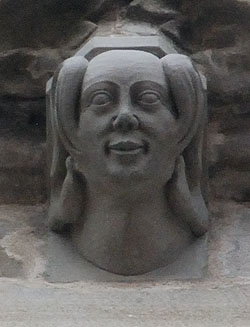 |
|
Outer defences to Château Comtal and Cité - part of the Aude barbican |
 |
|
Outer defences to Château Comtal and Cité - part of the Aude barbican |
 |
|
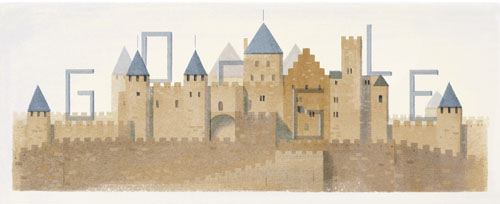
Google Doodle on 27 January 2014, marking
the bicentenary |
 |
|
Château Comtal |
 |
|
Outer defences to Château Comtal and Cité - part of the Aude barbican |
 |
|
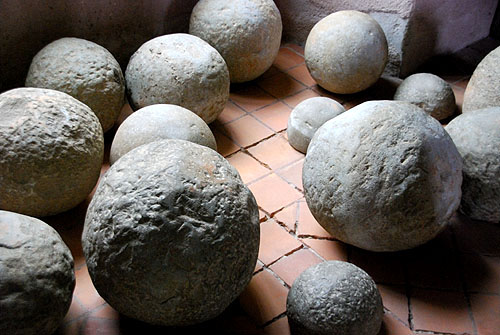
Trebuchet stones |
 |
|
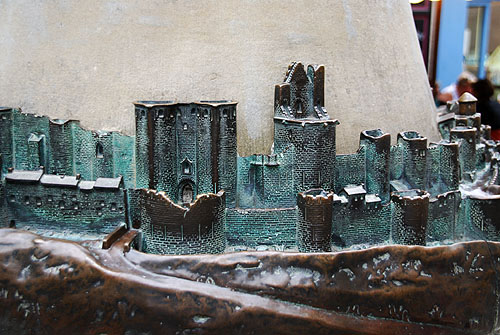
A memorial shows the state of the city walls before restoration - you can clearly see the Narbonne gate with no roof, a badly decayed barbican and the treasury to the right |
 |
|
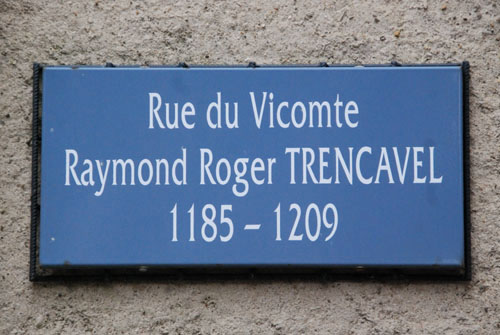
Road name commemorating the murdered Viscount |
 |
  |
|
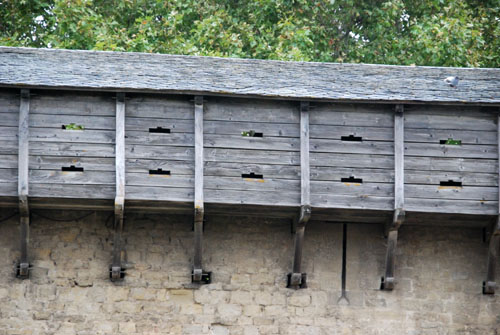
Hourdes on the walls of the Château Comtal |
 |
|
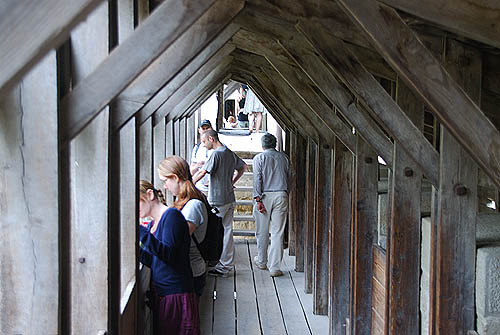
Inside the hourdes on the walls of the Château Comtal |
 |
|
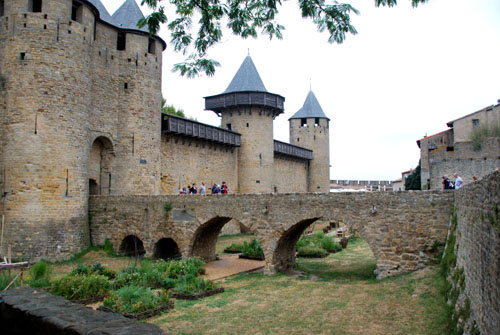
City entrance to the Château Comtal |
 |
|
Gargoyle on the Basilica of St Nazaire |
 |
|
Gargoyle on the Basilica of St Nazaire |
 |
|
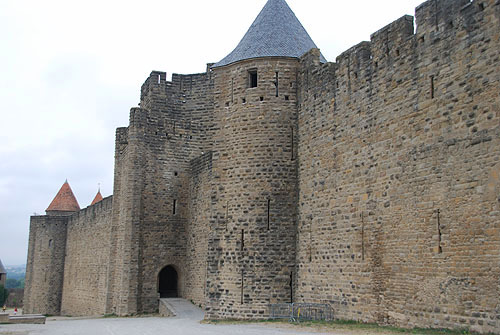
One of the four main entrances to the Cité |
 |
|
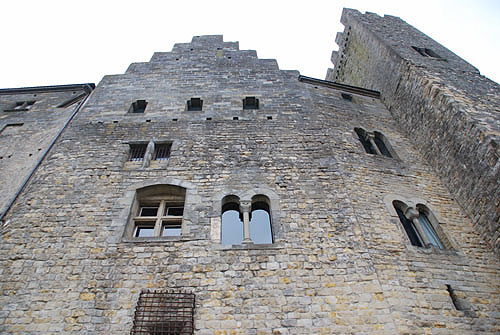
Château Comtal |
 |
|
Château Comtal |
 |
|
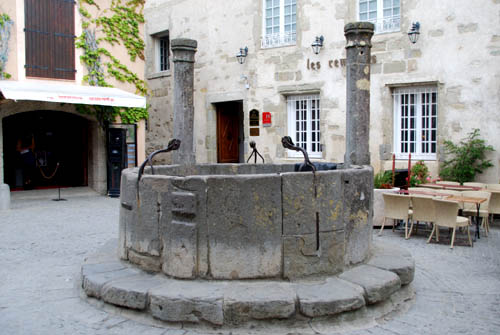
One of several wells in theCité |
 |
|
Cité ramparts |
 |
| Eternal stairway inside the Cité |
 |
|
Outer defences to Château Comtal and Cité - part of the Aude barbican |
.jpg) |
|
Outer defences to Château Comtal and Cité - part of the Aude barbican |
 |
|
Outer defences to Château Comtal and Cité - part of the Aude barbican |
.jpg) |
|
View of the Cité of Carcassonne |
.jpg) |
|
View of the Cité of Carcassonne |
.jpg) |
|
Aerial view of the Cité of Carcassonne |
 |
|
Outer defences to Château Comtal and Cité - part of the Aude barbican |
.JPG) |
|
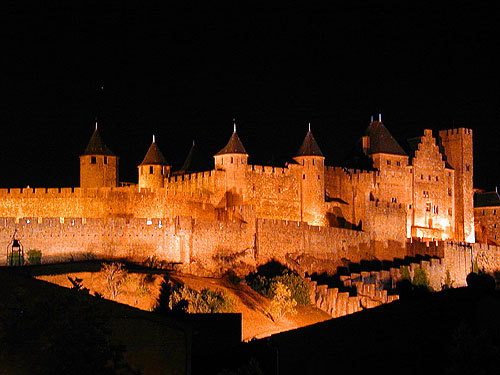
Outer defences to Château Comtal and Cité - part of the Aude barbican |
 |
|
View of the Cité of Carcassonne |
 |
|
Imagined view of the Cité of Carcassonne before the Cathar Wars |
|
|
Imagined view of the Cité of Carcassonne after the Cathar Wars (but before the Narbonne gate was rebuilt) |
 |
|
The Court du Midi Cité in the Château Comtal |
 |
|
The Court du Midi Cité in the Château Comtal |
 |
|
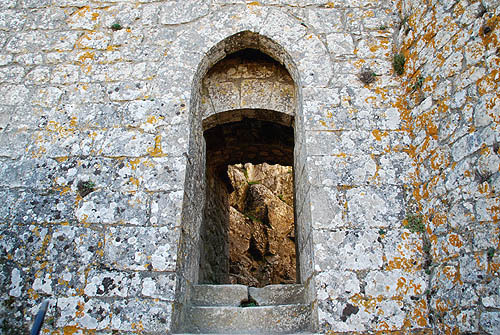
Postern gate |
 |
|
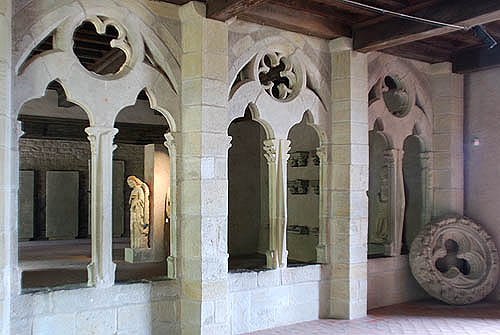
Museum in the Château Comtal |
 |
|
Medieval re-enactment at the Château
Comtal |
 |
|
Inside the Château Comtal |
 |
|
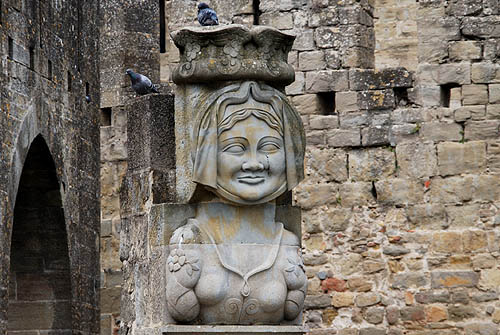
Dame Carcas - According to tradition she was a Muslim ruler of Carcassonne who cleverly saw off a Frankish siege |
 |
|
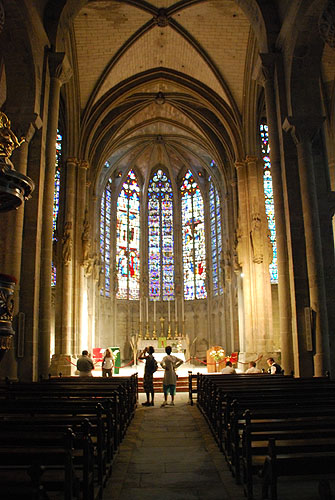
The Basilica of Saint Nazaire |
 |
|
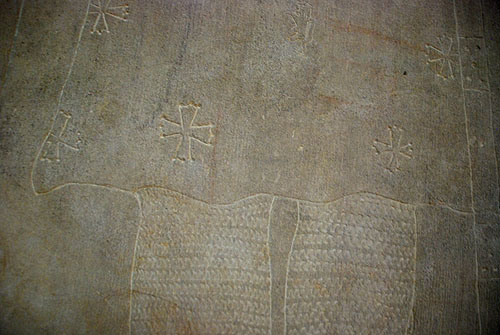
Near the bell is a slab on the wall depicting the death of Simon de Montfort in 1218 and his original tombstone |
 |
|
Close up of Simon de Montfort's surcoat on his original tombstone |
 |
|
An effigy of a bishop of Carcassonne - the Basilica was a Cathedral up until 1805 |
 |
|
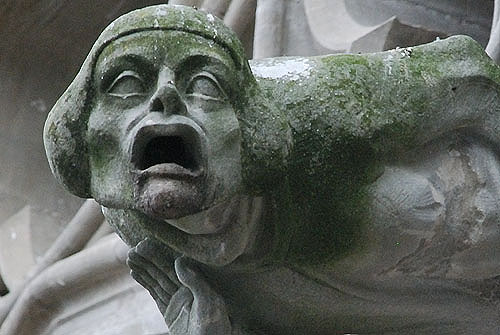
Gargoyle on the Basilica of St Nazaire |
 |
|
An unusual heraldic design known as camponny |
 |
| Aerial view of the Cité of Carcassonne |
.jpg) |
|
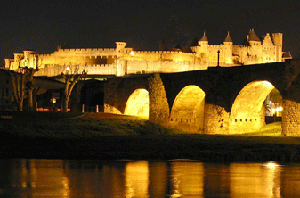
Château Comtal at night |
.jpg) |
|
View of the Cité of Carcassonne |
.jpg) |
|
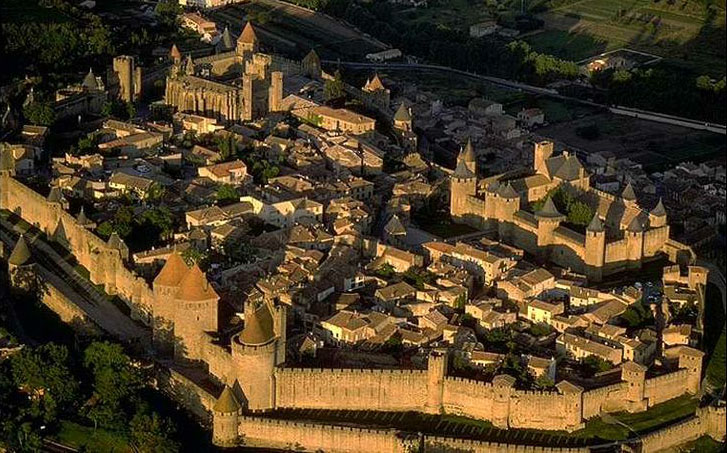
Aerial view of the Cité of Carcassonne |
 |
|
Views of the Cité of Carcassonne - drawings by Violet le Duc |
 |
|
View of the Cité of Carcassonne after restoration |
.jpg) |
|
|
|
|
|
|
|
|
|
|
||||
|
|||||||||


| :::: Link to us :::: Castle and Manor Houses Resources ::: © C&MH 2010-2016 ::: contact@castlesandmanorhouses.com ::: Advertising ::: |