|
|
|
|
|
|
|
|
|
|
|
|
|
|
|
Castle of Avignonet ( Castèl de Avignonet)
In the middle ages the Count of Toulouse had an important castle
at Avignonet-en-Lauragais. Its chatelain was the Count's nephew.
It is famous as the site of a massacre of a group of Inquisitors
in 1242, part of a general uprising against the invading French
crusaders. This event precipitated the final siege of Montségur
and caused heavy penances to be laid on the population of Avignonet-en-Lauragais.
Today, Avignonet-en-Lauragais is a small town in the Haute-Garonne
lying on the road between Carcassonne
and Toulouse,
the old Aquitaine road, not far from the Canal
du Midi and the modern motorway (A62). The castle is gone, but
marked by the village church.
See sepate sections below on:
Address /
Maps
/ Location
History
The Church
The Town
The Tower
Photographs
Deposition of Arnaud-Roger de Morepoix,
1244
|
|
|
Address
Contact
James McDonald
Tel from the US: 010 33 468 201142
Tel from the UK: 01 33 468 201142
Tel from France: 0468 201142
Tel other: + 33 468 201142
e-mail castlesandmanorhouses@gmail.com
|
|
|
|
Google Maps
|
|
|
Small scale map showing the location of
Château d'Avignonet (Lauragais) |
|
|
|
|
Google map showing the location of
Château d'Avignonet (Lauragais) |
|
|
|
|
Large scale map showing
Château d'Avignonet (Lauragais) |
|
|
|
|
Location
Avignonet-en-Lauragais is a small town in the Haute-Garonne lying
just off the main road between Carcassonne
and Toulouse,
the old Aquitaine road, not far from the Canal
du Midi and the modern motorway (A62).
|
|
|
History - Historical Significance
After
the failure of Raymond Trencavel II in 1240, Raymond
VII of Toulouse had one last hope of popular uprising in the
Languedoc against the French occupiers and the Inquisition.
The uprising was planned for 1242, supported by the Holy Roman Emperor,
James I King of Aragon, Henry
III King of England , Roger
IV Count of Foix, Raymond
Trencavel II, and other allies.
It proved a disaster. The Holy Roman Emperor kept delaying
until it was too late. Henry III was defeated at Taillebourg
by Louis
IX King of France. The Aragonese forces were not enough
to galvanise the exhausted population, and the new Count
of Foix deserted his family's ancient ally, sealing both their
fates.
The only achievement of note was the killing of a few widely hated
Inquisitors at Avignonet, along with their retinue, during the night
of 28 May 1242 by soldiers from Château
of Montségur ( Montsegùr)
led by Pierre-Roger de Mirepoix. The removal of these Inquisitors
was enormously popular. Church bells were rung to celebrate the
event as the solders passed through villages on their way home.
Montsegùr)
led by Pierre-Roger de Mirepoix. The removal of these Inquisitors
was enormously popular. Church bells were rung to celebrate the
event as the solders passed through villages on their way home.
The Château at Avignonet, where the Inquisitors were lodging,
belonged to Raymond
VII of Toulouse, and was kept by his his nephew, Raymond d'Alfaro.
The events at Avignonet prompted the final notable action of the
war - the famous siege of the Château
of Montségur (
Montsegùr)
in 1243-4. Many of those who had participated in the killing
of the Inquisitors
were captured at Montsegùr
and interrogated by the Inquisition. This is why historians have
a remarkable amount of detail about them and their movements.
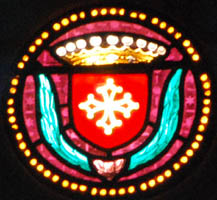 Today
the castle where the killing of the Inquisitors took place is gone,
but the church is built on the site of the castle chapel. As everywhere
else in the Languedoc, the people here are still proud to fly the
flag of their ancient count. The fact that the church here stands
on the site of his castle is commemorated in a small stained glass
window (shown above) depicting his arms surmounted by his coronet
with a star above. It may just be a coincidence, but the Cathars
thought of stars as perfected souls in heaven. Today
the castle where the killing of the Inquisitors took place is gone,
but the church is built on the site of the castle chapel. As everywhere
else in the Languedoc, the people here are still proud to fly the
flag of their ancient count. The fact that the church here stands
on the site of his castle is commemorated in a small stained glass
window (shown above) depicting his arms surmounted by his coronet
with a star above. It may just be a coincidence, but the Cathars
thought of stars as perfected souls in heaven.
Many attempts have been made to have the dead Inquisitors elevated
to sainthood - normally a formality for Catholic clergy killed for
"upholding the faith" - but the Inquisitors were widely
hated and a suitably discreet time for their canonisation has never
been found. The townspeople have still not forgotten that their
Catholic ancestors were punished by the Church for their complicity
for a generation after the killing.
The bodies of the dead Inquistors were taken back to Toulouse
to be buried in their respective churches. The three Dominicans
were buried together in Les Jacobins, but the church was rearranged
several times over the centuries. It is thought that their bones
were transfered to Saint Sernin at the Revolution.
|
|

|
|
The Church
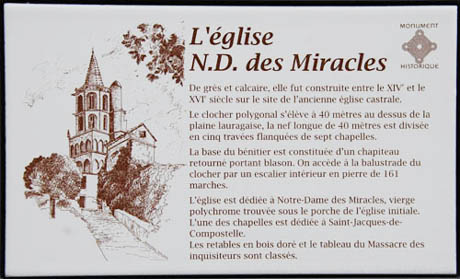
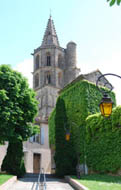
The church, dating from the Fourteenth and Sixteenth centuries
is constructed of limestone and sandstone.
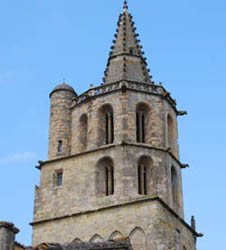
The polygonal tower rises 40 metres above the Lauragais plateau.
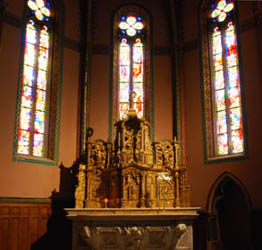
 The
nave is 40 metres long, with five bays on each side, seven of the
ten bays used as side-chapels and one housing the organ. The spectacular
alter features gilded wood. The
nave is 40 metres long, with five bays on each side, seven of the
ten bays used as side-chapels and one housing the organ. The spectacular
alter features gilded wood.
The church is dedicated to Our Lady of Miracles, one of the many
avatars of Mary the mother of Jesus.
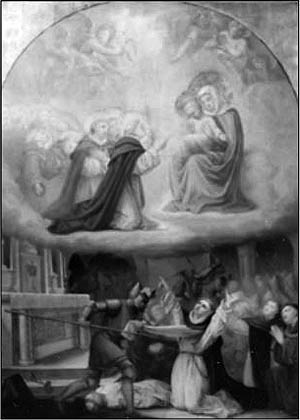
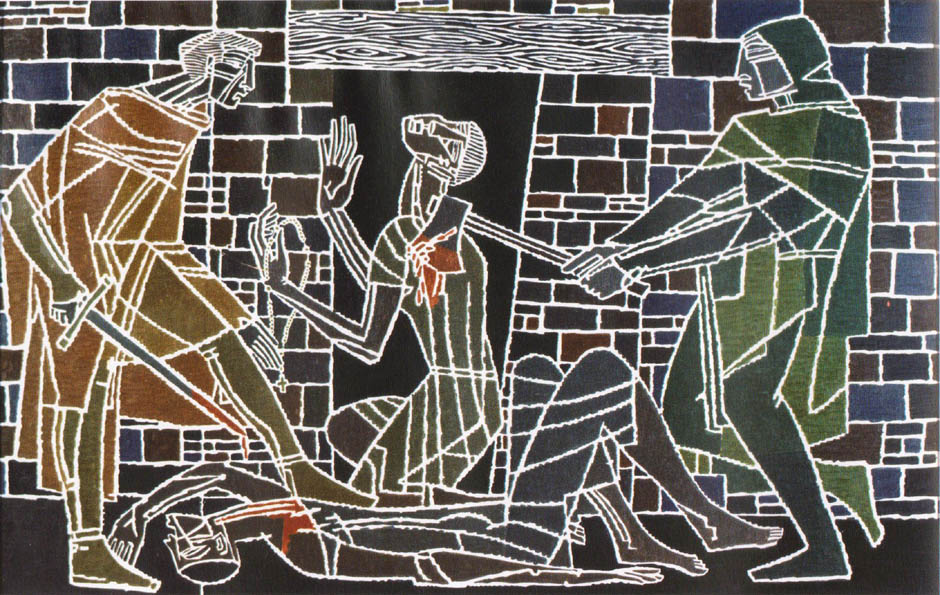
Towards the west end of the nave is an imaginative painting of
the Inquisitors being killed and being welcomed into heaven (shown
further up the page). There are also some interesting bosses in
one of the easternmost chapel on the south side.
|
|
The Church Tower
|
 |
| |
| |
 |
| |
|
|
|
|
|
The Town of Avignonet
The modern town is pleasant enough, or at least it was until a
wind farm was built next to it, so it and the surrounding countryside
is now disfigured by ugly modern windmills behind it and an electricity
station displayed prominently in front of it - next to the main
road without the slightest attempt at cosmetics or concealment.
In happier times the town grew rich through the Pastel
trade. Located between Carcassonne
and Toulouse
Avignonet lay within the
Land of Cocaigne, a large triangular area which grew
rich by making what was then an expensive and much sought after
blue dye. You can still see the large houses on the Grand rue, built
by merchants who grew rich on the trade.
|
|
|
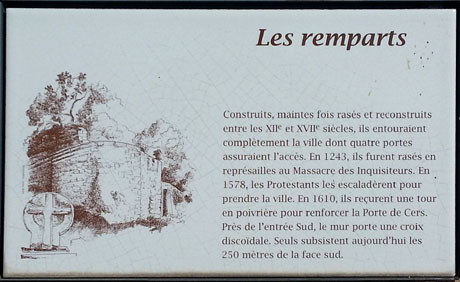
La Tour
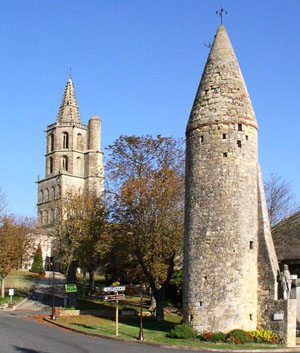
 "The
tower" is built in 1610 in the pepper pot style typical of
the period it was built. It was added to the "Cers gate"
the principal entrance to the west of the town, which still possessed
a draw bridge at that time. (The
Cers is one of the characteristic winds
in the Languedoc, blowing from the West or South-West). "The
tower" is built in 1610 in the pepper pot style typical of
the period it was built. It was added to the "Cers gate"
the principal entrance to the west of the town, which still possessed
a draw bridge at that time. (The
Cers is one of the characteristic winds
in the Languedoc, blowing from the West or South-West).
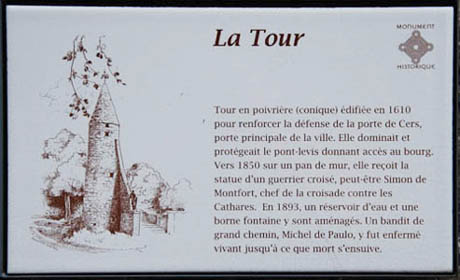
Later, around 1850 the statue of a crusader was added. Many have
interpreted this as a monument to the Inquisitors killed here, but
there is no evidence to support this idea. According to the panel
(photograph below) the figure may represent Simon
de Montfort who was himself already long dead at the time of
the killing. Oddly the knight's coat of arms bears the arms of the
town, while those of his shield show some other arms (not those
of Simon de Montfort).
|
|
|
|
|
GUIDED TOURS OF CATHAR CASTLES OF THE LANGUEDOC
You can join small exclusive guided tours of Cathar Castles
led by an English speaking expert on the Cathars
who lives in the Languedoc
(author of www.cathar.info)
Selected Cathar Castles. Accommodation provided. Transport
Provided.
Cathar Origins, History, Beliefs.
The Crusade, The Inquisition, and Consequences
Visit
the Cathar Tours Website for more information
|
|
|
|
La massacre des légats a Avignonet,
1960, by Jacques Fauché, oil on wood, 118 x 83cm
Inquisitorsat Avignonet are shown being hacked
to death by sword and axe in 1242
|
 |
|
Deposition to the Inquisition
|
|
Depositions of Arnaud Rodger de Mirepoix, (brother of Raimond
de Pareil, cousin of Pierre Roger) to the Papal Inquisition based
at Carcassonne,
Translated into French
|
Depositions of Arnaut Rotger de Mirepoix, (brother of Ramon de
Pareil, cousin of Peyre Rotger) to the Papal Inquisition based at
Carcassonne,
Translated into English (and leaving Occitan names in Occitan)
|
Dans son premier interrogatoire (12 avril 1244),
Arnaud Roger de Mirepoix raconte
:
Item, un jour (le 25 mai 1242), Guillaume de Plaigne
vint à Montségur et parla à part à
Pierre Roger de Mirepoix. Ce dernier m'appela ainsi que tous
les chevaliers et sergents du château et nous dit que
tous, tant chevaliers que sergents, nous nous préparions
à l'accompagner car il y avait grand butin préparé
pour nous.
Alors moi-même, Alzieu de Massabrac, Guiraud de Rabat,
Raimond de de Rabat, Bernard de Saint-Martin, Pierre de Saint-Martin,
Barrau, écuyer de Bernard de Saint-Martin, Guillaume
de Lahille, Pierre Landric, écuyer à l'époque
de Guillaume de Lahille,, Pierre Roger de Mirepoix, Perrou,
écuyer à l'époque de Pierre Roger, Gaillard
de Oth de Villarzel, Guillaume Azéma, Perrin de Pomas,
Raimond de Corbières, Raimond Guillaume Tournebois,
Pierre Roger de Lissac, fils de Jourdain de Lissac, Pierre
Vital, Guillaume de Tournebouix, Pierre de Montolieu, Oth
de Massabrac, Arnaud de Bensa, Pierre Faure de Saint-Martin-Lalande,
Jean Cathala, Imbert, Arnaud Gous, Guillaume Guibert, Guillaume
de Péreille et Raimond Monic sortîmes du château
et nous mîmes en route pour Avignonet (26 mai 1242)
Arrivés près de la force de Saint-Martin qui
s'appelle Genebrières (canton de Belpech - Aude), nous
y restâmes, moi et les autres ; Bernard Saint-martin
m'apporta alors à manger ainsi qu'à tous les
autres. En ce lieu vinrent Jourdain du Villar, fils de Pons
du Villar, Pierre Viel, Raimond de Verzeille (canton de Saint
Hilaire - Aude), Arnaud Izard, le neveu de Pierre Rais, Raimond
Aicart, Pierre Laurens, le bâtard de Mazerolles, Pons
del Capela junior et Astier, tous de Gaja et d'autres jusqu'à
vingt-cinq de Gaja.
Et, dans la nuit, moi-même et tous les autres (une
cinquantaine d'hommes) vînmes près du château
d'Avignonet. Quand nous fûmes auprès, tous ces
chevaliers et sergents, sauf moi, Alzieu de Massabrac, les
frères Guiraud et Raimond de Rabat et Pierre Roger,
entrèrent dans ce château d'Avignonet et tuèrent
les Frères, savoir Guillaume Arnaud et ses compagnons.
Après être restés dans le château
un certain temps, ils en sortirent, avec Guillaume Raimod
Golairan d'Avignonet, dans la maison duquel on avait fait
les chandelles. Donat d'Avignonet et plusieurs autres hommes
d'Avignonet, jusqu'à trente, qui avaient assisté
au meurtre des Frères et nous dirent à moi et
à tous ceux qui étaient avec moi, que frère
Guillaume Arnaud et son compagnon (frères prêcheurs),
étaient tués. Et Guilaume Golairan dit alors
qu'il n'avait jamais eu une telle joie de sa vie.
Après avoir entendu cela, moi-même et tous les
autres partîmes de là et prîmes la route
du château de Montségur.
Raimond d'Alfaro, le bayle du comte de Toulouse, Raimond
VII, a envoyé Guillaume de Plaigne à Montségur
pour que Pierre Roger de Mirepoix et les autres vinssent assassiner
ces Frères (26 mai 1242). Et c'est pour cette raison
que Guillaume de Plaigne eut le palefroi de Raimond Escribe,
archidiacre de l'évêché de Toulouse. Pierre
Roger de Mirepoix demandait avec beaucoup d'insistance la
tête de Frère Guillaume Arnaud Guillaume, disant
à ceux qui avaient pris part à sa mort qu'ils
ne feraient désormais plus rien qui lui fît plaisir,
parce qu'ils ne lui avaient pas apporté sa tête.
Pour l'époque, il y aura deux ans à la prochaine
Ascension (28 mai 1242 à Avignonet. Voilà donc
le récit du meurtre des inquisiteurs et de leur suite
par un témoin).
Dans le deuxième interrogatoire (4 mai 1244), Arnaud
Roger de Mirepoix ajoute à propos du massacre d'Avignonet
:
Item, Bertrand d'Aguilar et Guillaume Laurens, gendre d'Arnaud
Roger de Castillo en Catalogne (les principaux assassins du
massacre d'Avignonet) prirent part à la mort de Frère
Guillaume Arnaud et de ses compagnons ; après leur
mort, ils retournèrent au château de Montségur
avec Pierre Roger de Mirepoix. Et plusieurs fois ce Bertrand
d'Aguilar et ce Guillaume Laurens ont adoré Bertrand
Marty et ses compagnons parfaits à ma vue.
Pour l'époque, il y a deux ans ou environ.
Item, alors que le chevalier Ath Arnaud de Châteuverdun
était malade à Montgradail (canton d'Alaigne
- Aude) dans la maison d'Ermengarde de Routier de Fanjeaux,
qui fut la femme de Bernard de Pomas, il m'envoya chercher
et me dit qu'il voulait à tout prix se donner aux parfaits.
Vinrent alors les parfaits Guillaume Tournier et son compagnon.
Il y avait dans la maison avec ce malade quand les parfaits
arrivèrent moi-même, Huc de Durfort, Bernard
de Pomas, Arnaud de Miglos et le chevalier Isarn de Fanjeaux
qui amena ces parfaits avec moi, Guillaume de Lahille, Pierre
de Lahille et Sicard de Durfort, madame Cavaers (fille de
Bernard de Routier de Fanjeaux éxécuté
à Lavaur ; elle fut condamnée à la prison
perpétuelle) et Ermengarde de Routier, femme de Bernard
de Pomas. Et là moi-même et tous les autres avons
adoré ces parfaits comme il a été dit.
|
|
| In his first interview (12 April 1244), three weeks after
the massacre at Montsegur, Arnaut Rotger de Mirepoix says:
Item: one day (25 May 1242), Guilhem de Planh came
to Montsegur and spoke to Peyre Rotger de Mirepoix. The latter
called me and all the knights and sergeants of the castle
and told us all, both knights and sergeants, that we should
prepare to accompany him, because there was great booty prepared
for us.
So myself, Alzieu de Massabrac, Guiraut de Rabat, Ramon de
Rabat, Bernard de Saint-Martin, Peyre de Saint-Martin, Barrau,
squire to Bernard de Saint-Martin, Guilhem de Lahille, Peyre
Landric, écuyer à l'époque de Guilhem
de Lahille, Peyre Rotger de Mirepoix, Perrou, then squire
to Peyre Rotger, Gaillard de Ot de Villarzel, Guilhem Azéma,
Perrin de Pomas, Ramon de Corbières, Ramon Guilhem
Tournebois, Peyre Rotger de Lissac, fils de Jourdain de Lissac,
Peyre Vital, Guilhem de Tournebouix, Peyre de Montolieu, Ot
de Massabrac, Arnaut de Bensa, Peyre Faure de Saint-Martin-Lalande,
Jean Cathala, Imbert, Arnaut Gous, Guilhem Guibert, Guilhem
de Péreille et Ramon Monic left the castle and set
off for Avignonet [26 May 1242]
We arrived near the Force de Saint-Martin, called Génébrières
[canton of Belpech], we stayed there, me and the others; Bernard
Saint-Martin then brought us food. We were joined there by
Jourdain du Villar, son of Pons du Villar, Peyre Viel, Ramon
de Verzeille [canton of Saint Hilaire], Arnaut Izard, the
nephew of Peyre Rais, Ramon Aicart, Peyre Laurens, the bastard
Mazerolles, Pons del Capela junior and Astier, all from Gaja,
along with twenty-five others from Gaja .
And at night, myself and all others (around fifty men) came
to a place [Antioch] near the Castle of Avignonet. Once we
had arrived, all of these knights and sergeants, except me,
Alzieu de Massabrac, the brothers Guiraut de Rabat and Ramon
de Rabat, and Peyre Rotger [de Mirepoix ?], entered this castle
and killed the Brothers, namely Guilhem Arnaut and his companions.
After staying in the castle for some time, they came out with
Guilhem Ramon Golairan d'Avignonet, in whose house the candles
had been made. Donat d'Avignonet and other men from Avignonet,
around thirty, who had witnessed the killing of the Brothers,
said to me and to all those who were with me, that Brother
Guillaume Arnaud and his companion, had been killed. Guilaume
Golairan then said that he had never had such a joy to his
life.
After hearing this, I and all others departed from there
and took the road to the Castle of Montsegur.
Ramon Alfaro, the bailiff of the Count of Toulouse, Raymond
VII, had sent Guilhem de Planh to Montsegur for Peyre Rotger
de Mirepoix and the others to come to assassinate these Brothers.
And it is for this reason that Guilhem de Planh had the palfrey
belonging to Ramon Escribe, archdeacon of the diocese of Toulouse.
Peyre Rotger de Mirepoix asked very emphatically for the head
of Brother Guillaume Arnaud, telling those who had taken part
in his death they would never be able do anything to make
him happy again, because they had not brought him his head.
As for the time, it will be two years next Ascension. Such
is the story of the murder of the inquisitors and other events,
by an eye witness.
In the second interview (4 May 1244), Arnaut Rotger de Mirepoix
adds to the massacre Avignonet :
Item: Bertrand d'Aguilar and William Laurens, son-in-law
of Arnaut Rotger Castillo in Catalonia took part in the death
of Brother William Arnaud and his companions; after the Brothers'
death, they returned to the castle of Montsegur with Peyre
Rotger de Mirepoix. And on many occasions I have seen Bertrand
Aguilar and William Laurens adore Bertrand Marty and his fellow
Perfects.
As for the time, this was about two or years.
Item , while the knight Ath Arnaut Châteuverdun was
sick at Montgradail [canton of Alaigne] in the house of Ermengarde
de Tours de Fanjeaux, who was the wife of Bernard de Pomas,
he sent for me and told me he wanted at all costs to give
himself to the Perfects. Then came the Perfect Guilhem Tournier
and his companion.
There was in the house with the patient, when the perfect
arrived, myself, Huc de Durfort Bernard de Pomas, Arnaut de
Miglos and the knight Izarn de Fanjeaux who brought these
Perfects with me, Guilhem de Lahille , Peyre de Lahille and
Sicard de Durfort , Madame Cavaers (daughter of Bernard de
Routier de Fanjeaux, executed at Lavaur; she was sentenced
to life imprisonment) and Ermengarde de Tours, the wife of
Bernard de Pomas. And there I and everyone else adored these
Perfects, as has been said.
|
|
|
|
|
We do not know the exact route taken by the knights from Montsegur
to Avignonet and back, but we do know some of the places they passed
through. This is a Google map with a route obtained by specifying
the known places in order and asking for an optimised walking route.
It is therefore a reasonable approximation to the route taken by
the knights.
The place known to Google as "La Tour" was known to the
knights as "Antioch".
The walk takes 32 hours round trip to cover 150 km - about right
allowing for the fact that, although the knights were mounted for
most of the journey, they would have been accompanied by foot soldiers.
|
|
|
|
Clik here for a detailed
account of what seems to have become of the relics of the the three
Dominicans massacred at Avignonet (in French)
|
Photographs
|
|
|
|
|
|
|
| |
|
|
|
|
|
|
|
|
|
|
|