 |
|
|
|
|
|
|
|
|
|
|
|
|
|
|
Château de Castelnaudary ( Castèlnòu d'Arri)
Castelnaudary is a commune in the Aude department in the Languedoc-Roussillon
region in south France. It is in the former province of the Lauragais
and famous for cassoulet of which it claims to be the world capital,
and of which it is a major producer.
September 1211 saw the first Siege of Castelnaudary
during the Cathar (or Albigensian) Crusades. Simon de Montfort was
besieged in Castelnaudary by the Count of Toulouse and his ally
the Count of Foix. The outcome was inconclusive. July 1220 to March
1221 saw a second siege of Castelnaudary
Today there are no remnants of the Cathar period to see at Castenaudary.
En 1623, Louis XIII had the château de Castelnaudary demolished.
At the end of the XVII century a prison was built on the site which
functioned until 1926. Today the building on the site is known as
the Présidial a primary school, prison, and museum, also
a small prison chapel chapel Saint-Pierre
See sepate sections below on:
Address / Maps
/ Location
History
Architecture
Photographs
|
|
The Présidial
|
 |
|
|
| |
|
|
Address
|
|
|
|
Google Maps
|
|
|
Small scale map showing the location of
Château de Castelnaudary |
|
|
|
|
Google map showing the location of
Château de Castelnaudary |
|
|
|
|
Large scale map showing
Château de Castelnaudary |
|
|
|
|
Location
Castelnaudary is a market town, and the capital of the territory
of Lauragais. The town is located 50 km southeast of Toulouse, about
midway along the route from that city to the Mediterranean. This
route has been used since at least Roman times, and today carries
road, motorway (A61), rail and canal links.
Castelnaudary is the main port of the Canal du Midi to which it
owed a period of prosperity in the 17th century when agricultural
and manufactured produce became easier to export. The Grand Bassin
in the town is at 7ha the largest open area of water in the canal,
and is today its major pleasure port.
Inhabitants of Castelnaudry are called Chauriens.
The name Castelnaudary comes from the Occitan Castèlnòu
d'Arri, in Latin Castellum Novum Arri, or Arrius' new castle.
|
|
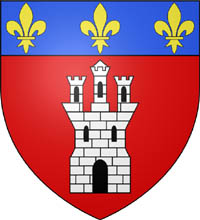
Modern Arms of Castelnaudar(with the arms
of "France Modern" in chief - a common feature of
towns that have become French since Medieval times
|
 |
|

|
|
History
Events of 1211.
The Meridional forces (under Count of Toulouse
and his allies the Count of Foix and Savaric de Mauléon)
were besieging Castelnaudary where Simon de Montfort and his French
Crusader army were holed up. The meridional's encampment was strong
but did not entirely surround the walls of the town.
Following the advice of Hugues de Lacy, Simon sent some knights,
among them Guy de Lévis and Bouchard de Marly, to seek as
many reinforcements as possible. Martin d'Algai and his mercenaries
rode to reinforce them, but the Count of Foix planned to ambush
them near the castle of Saint-Martin, 3 miles from Castelnaudary.
Simon got wind of this and sent Guy de Lucy, Simon de Neauphle,
Roard de Donges and 40 other knights to their rescue.
The Count of Foix returned to Castelnaudary bringing more troops
which, when the battle started, he organised in 3 battallions (heavy
cavalry at the centre, lighter cavalry on one wing, infantry on
the other). It appears that the Count of Foix acted on his own,
without support from the other lords.
Outnumbered, Martin d'Algai's mercenaries fled, which incited some
of Foix's troops to plunder the baggage train and leave the battlefield
while the fierce cavalry battle continued.
Simon, who had seen this, dashed out of Castelnaudary with 60 knights
leaving only 5 knights and the infantry to defend the castle against
de Mauléon's attacks.
Now the Count of Foix was in danger and his troops fled in disarray.
Severe losses had been inflicted on both sides.
The following day, Simon left Castelnaudary, leaving only a small
garrison.
A few days later, the Meridionals raised the siege.
Both sides claimed victory.
Some Key Dates
1103. First official mention of a settlement at Castelnaudary.
1211. During the Albigensian Crusade, Simon de Montfort, 5th Earl
of Leicester is besieged in Castelnaudary by the Count of Toulouse
and the Count of Foix.
1235. Arrival of the Papal inquisition whose initial attempts to
identify and persecute Cathars were unsuccessful due to the solidarity
of the townsfolk.
31 October 1355. During the 100 Years War, the town is sacked by
the Black Prince who travelling from Bordeaux, ravaged the weaker
towns of Gascony and then the Lauragais as far as Narbonne. The
town was pillaged and the inhabitants massacred. The town's walls
were not rebuilt until 10 years later.
1477. The town becomes the capital of the comté of Lauragais
under Louis XI of France.
In January 1477 Louis XI elevated the Lauragais area to the rank
of County, which he exchanged against that of Boulogne-sur-Mer (which
then belonged to Bertrand VI de la Tour d’Auvergne). Catherine
de Medici, his grand-daughter and Queen of France inherited the
County of Lauragais.
In 1554 – with the King’s agreement – she made
Castelnaudary the seat of the Sénéchaussée
(governor’s jurisdiction) for the County. The civil and criminal
court of justice – also called Présidial – was
then built next to the castle and completed in 1585.
|
|
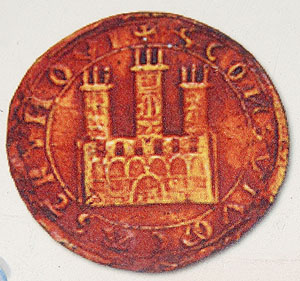
Medieval seal of the Castrum of Castelnaudary
|
 |
|
| |
| |
|
|
| |
| |
| |
| |
|
|
| |
|
|
Architecture
|
|
|
|
|
GUIDED TOURS OF CATHAR CASTLES OF THE LANGUEDOC
You can join small exclusive guided tours of Cathar Castles
led by an English speaking expert on the Cathars
who lives in the Languedoc
(author of www.cathar.info)
Selected Cathar Castles. Accommodation provided. Transport
Provided.
Cathar Origins, History, Beliefs.
The Crusade, The Inquisition, and Consequences
Visit
the Cathar Tours Website for more information
|
|
|
|
Siege of Castelnaudary
|
|
|
|
|
The Siege of Castelnaudary, 1211, illustrated
by Forester Roberts
|
 |
|
|
|
Towns all along the Canal du Midi have roads
named after Pierre-Paul Riquet, Baron de Bonrepos (1609 -
1680) was the engineer and canal-builder responsible for the
construction of the Canal du Midi.
Paul Riquet was born in Béziers. As
a youth, Riquet was interested in mathematics and science.
As a fermier général ("farmer-general")
of Languedoc-Roussillon, he was responsible for the collection
and administration of the gabelle (salt tax) in Languedoc.
He was also a munitions provider to the Catalonian Army.
Riquet is the man responsible for building
the 240-kilometre-long artificial waterway that links the
southern coast of France to Toulouse (linking to the canal/river
system that ran across to the Bay of Biscay), one of the great
engineering feats of the 17th century. The logistics were
immense. Planning, financing, and construction of the Canal
du Midi completely absorbed Riquet from 1665 forward. The
high cost of construction depleted Riquet's personal fortune
and the seemingly insurmountable problems caused his sponsors,
including Louis XIV, to lose interest. Riquet's major engineering
achievements included the Fonserannes Lock Staircase and the
Malpas Tunnel, the world's first navigable canal tunnel. The
canal was completed in 1681, eight months after Riquet's death.
|
 |
|
 |
 |
| |
|
The rather crudly worked figures of Raymond
of Toulouse and Simon de Montfort at Castelnaudary (photos
above) are accompanied by a plaque (below) commemorating the
Siege of Castelnaudary in 1211. First a translation in English.
KNIGHTS OF CASTELNAUDARY
SIMON DE MONTFORT ( LEFT) FACES RAYMOND DE TOULOUSE (RIGHT
)
These giants represent the two counts facing each other at
the siege of Castelnaudary, in 1211.
They are the work of the association "Les Gauvois de
Villeneuve-la-Comptal " based on an idea of Claude Quemerais,
the association's president .
In 2011, these two figures took to the streets on the Chariot
Villeneuve-la-Comptal during the festival of Cassoulet of
Castelnaudary and participated in 800th anniversary of the
Battle of Saint Martin Lalande - Lasbordes .
The Siege of Castelnaudary,
a memorable episode during the Albigensian Crusade .
By September 1211, Count Simon de Montfort, leader of the
Crusade had waged war for two years already, against the Cathars
and Occitan lords who protected them. His troops were insufficient
and the Languedoc was hostile. On the advice of his lieutenant,
Hugh de Lacy, he took refuge with sixty knights and a few
hundred armed men in Castrum of Castelnaudary , "el plus frevol
Castel" (the weakest castle), according to the Canso [Song
of the Crusade] by William of Tudela.
Count Raymond VI of
Toulouse, along with Raymond Roger de Foix, Bernard de Comminges,
Gaston de Béarn, the Seneschal [of King John of England]
Savary de Mauléon, and a multitude of barons, knights
and routiers [mercenaries] immediately sped to Castelnaudary
to besiege Montfort. "They covered the plain like locusts".
The citizens of Castelnaudary saw tents and pavilions erected
on this plain, surmounted by a golden orb and and eagle of
iron. They descended from the city to swear an oath of allegiance
to the Count of Toulouse
At night, the Crusaders
took their horses to Fresquel to water them. On the way they
raided ripe grapes from the vineyards. The Occitan forces
had to repel such sorties by Simon de Montfort. To defend
their camp, the Occitan forces raised palisades and dug ditches,
"so well that they could be called the besieged rather than
the besiegers" according to [the Cistercian chronicler] Pierre
des Vaux de Cernay.
The Occitans managed
to erect a perrière [a huge catapult] on the Pech (la
colline du Moulin de Cugarel ) to catapult stones, but the
Lauragais stone was to soft and friable, and broke against
the outer walls of Castelnaudary. Raymond Roger de Foix attempted
an assault against the de Mauléon gate [of the City],
but in vain. The Count was informed that an enemy column from
Narbonne, was on the way to Castelnaudary, bringing supplies
to Simon de Montfort. He left to intercept them between Saint
Martin Lalande and Lasbordes. Learning that the French were
retreating and taking flight, Simon de Montfort sped to their
rescue. He left just five Knights and a handful of men to
guard Castelnaudary.
The Count of Toulouse,
refusing to take advantage, remained in his tent. Savary de
Mauléon, belonging to the Occitan coalition, with his
knights and routiers, led an assault on Castelnaudary. Finally,
Savary de Mauléon was pushed back by the valiant French
Crusaders who remained inside the City.
Simon de Montfort returned
to Castelnaudary in the evening after the Battle of Saint
Martin Lalande - Lasbordes. Barefoot, he entered the city
church to give thanks to the Almighty for his favour, and
sang a Te Deu , then he abandoned Castelnaudary, leaving
it to raise new troops.
On the Occitan side,
the Count of Toulouse immediately raised the siege, while
the Count of Foix sent out messengers proclaiming that Simon
de Montfort had been caught and hanged. Due to this stratagem,
fifty fortresses held by the French Crusaders surrendered
to Occitan forces immediately after the siege of Castelnaudary
.
(Incidentally, this one vignette very neatly
sums up the characters and military abilities of Raymond VI
of Toulouse, Simon de Montfort, and the Count of Foix)
|
 |
| |
| |
|
Text from the above
|
 |
 |
|
|
|
| |
|
|
|
|
|
|
|
|
|
|
|


