 |
|
|
|
|
|
|
|
|
|
|
|
|
|
|
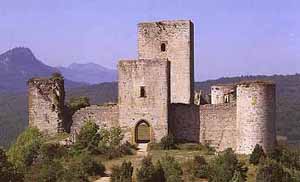
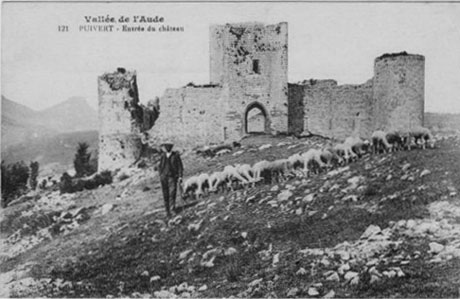
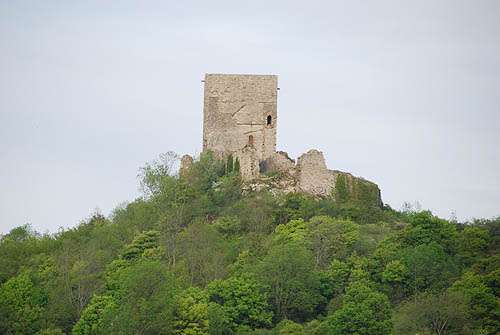
Castle of Puivert ( Castèl de Puègverd)
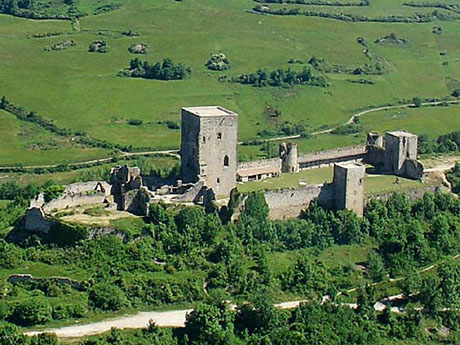
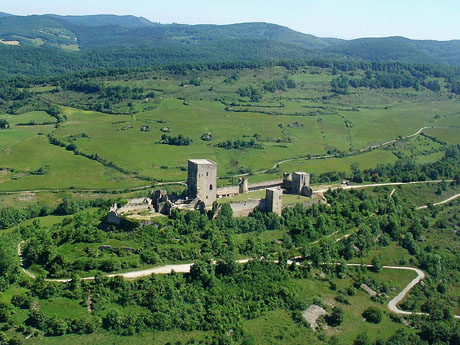
The Château de Puivert is a Cathar castle situated in the
commune of Puivert, in the Aude département of the Languedoc.
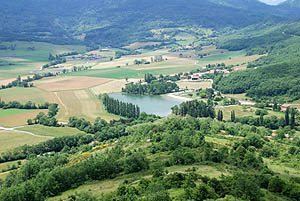
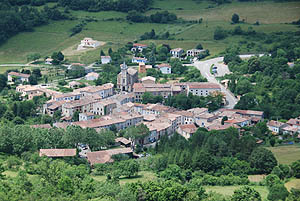
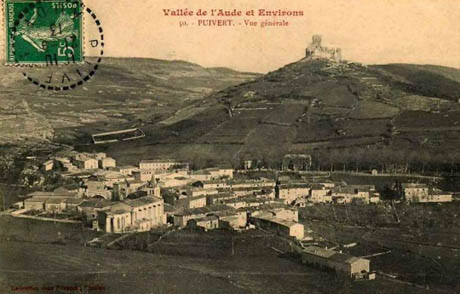
This building, on top a hill overlooking the village and its lake,
reaches an altitude of 605 m.
n the twelfth century a castle stood on this site, which had strong
Cathar
and troubadour
links. A meeting of troubadours
took place here in 1170, and in 1185 festivities attended by the
Viscount of Carcassonne
and Loba, Lady of Lastours
(Cabaret).
The castle has been listed as a monument historique by the French
Ministry of Culture since 1902. The castle of Puivert is still in
relatively good condition. It is privately owned, but open
to the public and undergoing restoration.
See separate sections below on:
Address / Maps
/ Location
History
Architecture
Photographs
|
|
Entrance with drawbridge and portcullis
|
 |
|
|
| |
|
|
Address
Contact
James McDonald
Tel from the US: 010 33 468 201142
Tel from the UK: 01 33 468 201142
Tel from France: 0468 201142
Tel other: + 33 468 201142
e-mail castlesandmanorhouses@gmail.com
|
|
|
|
Google Maps
|
|
|
Small scale map showing the location of
Château de Puivert |
|
|
|
|
Google map showing the location of
Château de Puivert |
|
|
|
|
Large scale map showing
Château de Puivert |
|
|
|
|
Location
 The
site is in the Quercob region, 60 km (40 miles) south of Carcassonne
and 45 km (30 miles) east of Foix. The
site is in the Quercob region, 60 km (40 miles) south of Carcassonne
and 45 km (30 miles) east of Foix.
Phone : + 04 68 20 81 52 Fax : + 04 68 20 81 52. Opening times:
April 1 to September 30. 8am to 8pm - October 1 to 31 March from
10am to 5pm
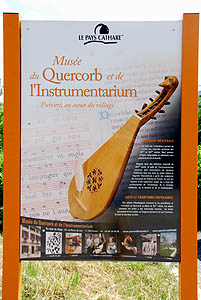
In the nearby village of Puivert you can visit the "musée
du Quercorb". (The Quercorb is the area around Puivert.)
Puivert lies at 42°54'44" N, 2°03'34"
E
|
|

|
|
History
At the meeting of 1170 a troubadour
called Peire d'Auvergne penned a satirical Occitan
poem which concluded with the words
Lo vers fo fats als enfobatz
A puich-vert tot jugan rizen |
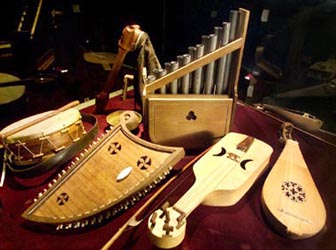
This poem was composed to the sound of bagpipes
At Puivert among song and laughter |
 At
the start of the Wars against the Cathars, the so-called Albigensian
Crusade, Puivert's seigneur was Bernard de Congost. His wife
Alpaïs had become a Parfaite
before her death just a year earlier in 1208. At
the start of the Wars against the Cathars, the so-called Albigensian
Crusade, Puivert's seigneur was Bernard de Congost. His wife
Alpaïs had become a Parfaite
before her death just a year earlier in 1208.
In November 1210 the Castle was besieged (just after the fall
of Termes)
by Simon
de Montfort, and fell after three days. The dispossessed
Congost family carried on the fight against the invaders.
Bernard died after receiving the Cathar
Consolamentum at Montségur
in 1232. His son fought on, participating in the events of Avignonet
in 1242 and helping defend the Château
of Montségur ( Montsegùr)
in 1243-4.
Montsegùr)
in 1243-4.
 In
1213 the seigneurie, now in French hands, was conferred by Simon
de Montfort on one of his lieutenants, Lambert de Thury. Later
it was allocated to Pons de Bruyère. In
1213 the seigneurie, now in French hands, was conferred by Simon
de Montfort on one of his lieutenants, Lambert de Thury. Later
it was allocated to Pons de Bruyère.
At the start of the 14th century, probably around 1310,
Thomas de Bruyère, grandson of Pons, built the present
castle, to the east of the old "Cathar castle". His
wife was Isabelle de Melun, daughter of a Grand Chamberlain of
France, whose arms are still to be seen in the building.
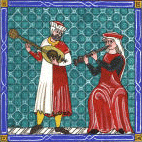
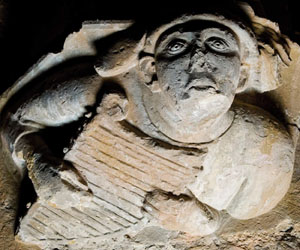
One room has fine carvings of minstrels, and tourists are often
told that troubadours
played in this room. This is absolute rubbish, but if you
look behind the castle you will find the foundations of the earlier
castle where troubadours really did play.
The castle, 600 meters (1970 feet) above sea level, is sited on
a green hill top (Puig-Vert). Perhaps the significance of the name
is that most castles in the area are not on green hill tops, but
rocky mountain tops.
Some points of note are:
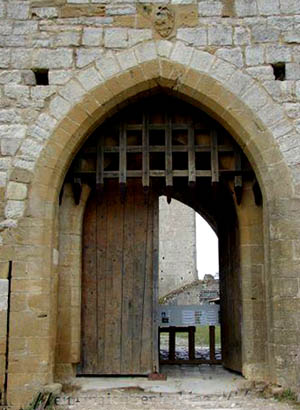
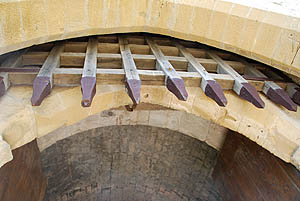
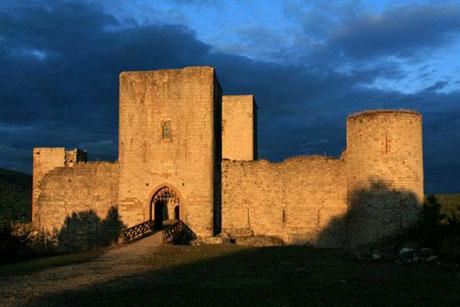
- the tower gate on the east side of the courtyard. You can see
the de Bruyère arms (a lion rampant with a forked and knotted
tail) carved in stone above the doorway. The bridge over the ditch
would have been a drawbridge. You can still see the portcullis,
and the two holes where beams would have projected to hoist the
bridge.
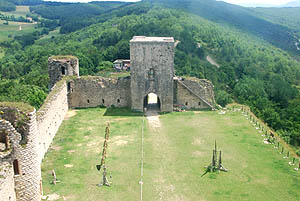
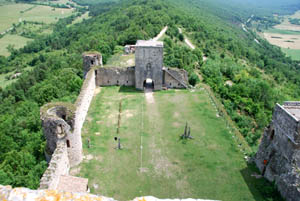
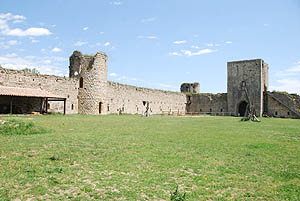
- the courtyard is 80 meters long and 40 wide (260 x 130 feet),
surrounded by a curtain wall and the remains of six towers. In
the Northwest corner is a postern gate (used for surprise sorties
against besiegers) called the Chalabre Gate
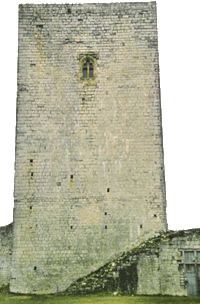
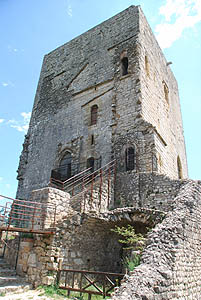
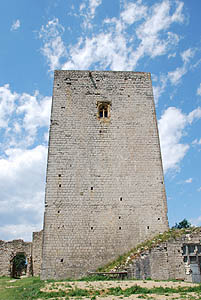
- the donjon (keep) is 35 meters (115 feet) tall and 15 meters
(49 feet) across each side. On the west of the keep are traces
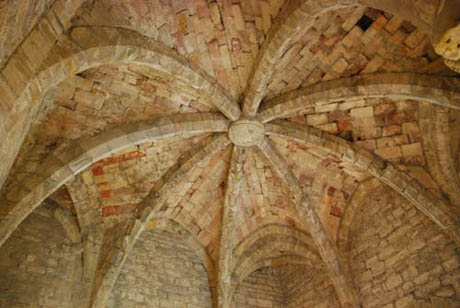
of an adjoining building. Each of the four stories contains a
single room, with a defensive platform at the fifth level. The
keep comprises:
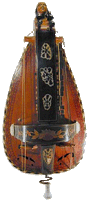
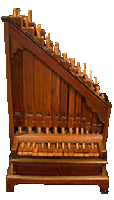
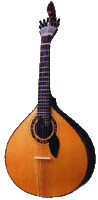
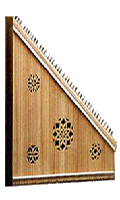
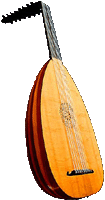
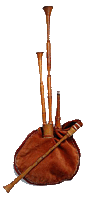
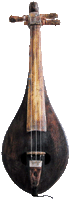
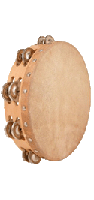
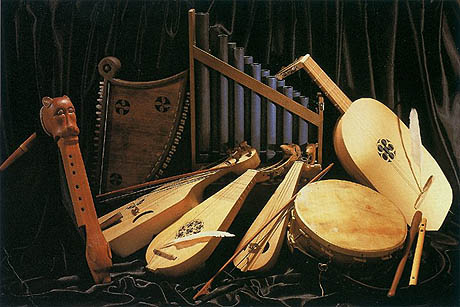
Medieval Musical Instruments
| Hurdy Gurdy |
Portative Organ |
Cithern |
Psaltery |
 |
 |
 |
 |
| |
|
|
|
| Lute |
Cornemuse |
Rebec |
Tambourine |
 |
 |
 |
 |
| |
|
|
|
 Of
all the Cathar
castles, Puivert is one of the best preserved. With its 35 meters
high keep in which four splendid rooms are superimposed, its towers
incorporated in its enclosure wall, this castle dominates the old
glacial lake of Puivert below. Of
all the Cathar
castles, Puivert is one of the best preserved. With its 35 meters
high keep in which four splendid rooms are superimposed, its towers
incorporated in its enclosure wall, this castle dominates the old
glacial lake of Puivert below.
You can climb to the top of the donjon (keep) from where you can
see the Quercorb plain to north and the peak of Bugarach to the
east. To the west you can just see Montségur
with the the high Pyrenees
behind it. The pall of black smoke rising from Montségur
on the morning of 16 March 1244 would have been clearly visible
from here.
The castle was classified as an Historic Monument (Monument historique)
in 1907.
|
|
|
|
Ruins of the Earlier Chateau
adjacent to the existing Château de Puivert
|
|
|
|
|
|
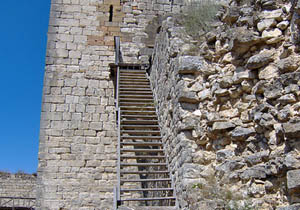
Access to the Walls of the Château
de Puivert
|
 |
|
|
|
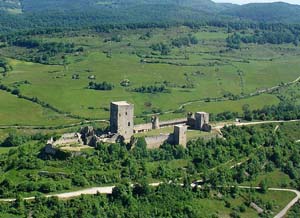
Silhouette of the Château de Puivert
|
 |
|
|
|
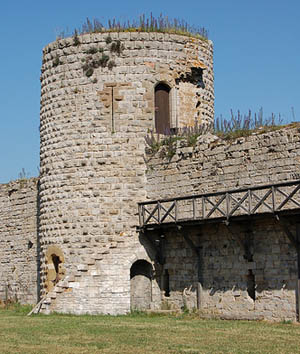
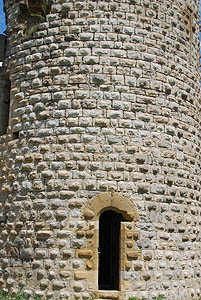
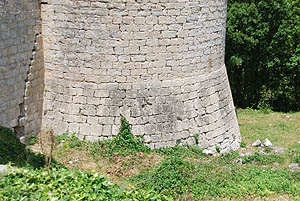
Intramural tower, Château de Puivert
|
 |
| |
|
Gate with portcullis, Château de Puivert
|
 |
| |
|
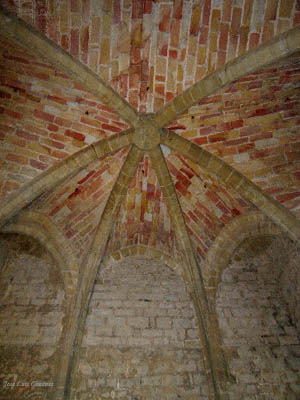
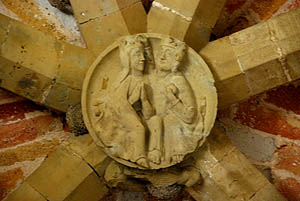
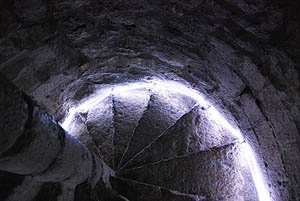
Vaulting in the Keep, Château de Puivert
|
 |
| |
|
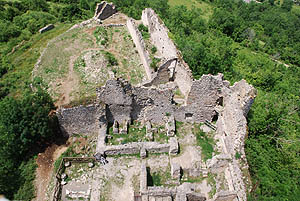
Aerial view of the Château de Puivert
|
 |
| |
|
|
| |
|
|
Architecture
 The
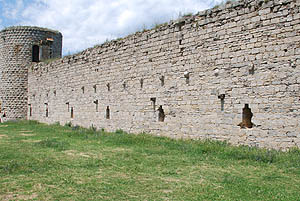
curtain wall, pierced with arrow slits or loopholes (flecheres),
extends some 175 m. In plan the grounds are rectangular with a
surface area of around: 3,200 m². A moat which separated
it from the plateau is almost indistinguishable today. The
curtain wall, pierced with arrow slits or loopholes (flecheres),
extends some 175 m. In plan the grounds are rectangular with a
surface area of around: 3,200 m². A moat which separated
it from the plateau is almost indistinguishable today.
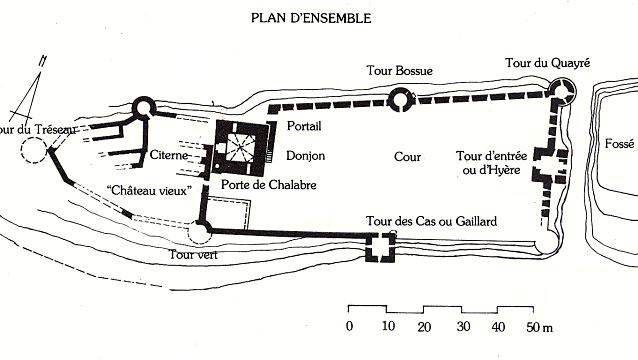
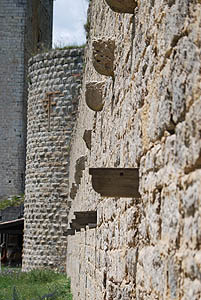
The main entrance to the courtyard is through a square tower
situated in the canter of the east wall. Of the original towers
there remain:
- the keep (the best preserved part of the castle).
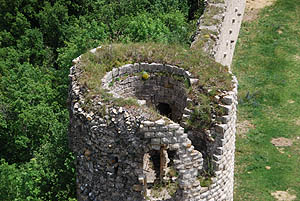
- a smooth round tower in the Northeast corner
-
a rough (bossed) round tower in the middle
of the north wall
-
a square tower, with a windowed turret on
the east side
-
the remains of a round tower in the Southeast
As well as the central gateway in the east wall there are two
other gateways: one in the Northwest corner (defended by the keep)
and another to the south of the keep giving access to the original
castle on this site.
|
| |
| |
|
cousieges - Château de Puivert
|
 |
| |
| |
|
| |
|
Château de Puivert - Plan
|
 |
|
|
|
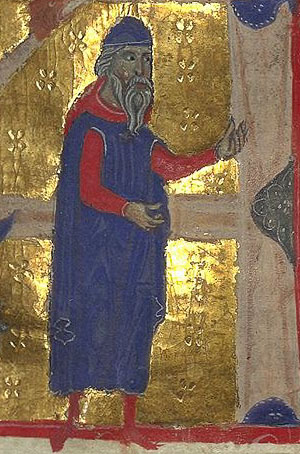
Peire d'Alvernhe (Pierre d'Auvergne)
Peire d'Alvernhe is one of the best known troubadours.
Peire's most famous work is Chantarai d'aquest trobadors,
a sirventes written at Puivert in which he ridicules twelve contemporary
troubadours ("a poetical gallery") and himself. It has
been conjectured that this piece was first performed in the presence
of all twelve of the ridiculed poets in late Summer 1170 while
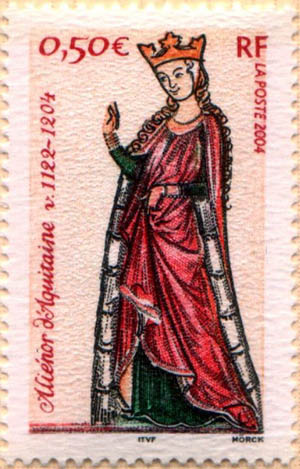
an embassy bringing Eleanor, daughter of Henry II of England,
to her Spanish groom Alfonso VIII of Castile stayed at Puivert
(accompanied by her mother Eleanor of Aquitaine)
The obscurity of most of the twelve poets and the attack upon
such personal characteristics as appearance and manners suggests
that the parody was good natured and performed in the presence
of all twelve victims.
The poem, a sirventes, is reproduced below with a few of the
verses translated into English.
It concludes
This verse was made to the sound of bagpipes
at Puivert, with much laughter and play.
|
|
Peired'Alvernhe - BnF MS12473 fol.
|
 |
| |
| |
|
|
|
Peire d'Alvernhe, Chantarai d'aquest trobadors
|
Cantarai d'aqestz trobadors
Que canton de maintas colors
E•l pieier cuida dir mout gen!
Mas a cantar lor er aillors
Q'entrametre•n vei cen pastors
C'us non sap qe•s mont'o-s dissen.
|
I shall sing about those troubadours
who sing in many fashions, and all praise
their own verses, even the most appalling;
but they shall have to sing elsewhere,
for a hundred competing shepherds I hear,
and not one knows whether the melody's rising or falling.
|
|
D'aisso mer mal Peire Rotgiers,
Per qe n'er encolpatz primiers,
Car chanta d'amor a presen!
E valgra li mais us sautiers
En la glieis'o us candeliers
Tener ab gran candel'arden.
|
In this Peire Rogier is guilty,
thus he shall be the first accused,
for he carries tunes of love in public right now,
and he would do better to carry
a Psalter in church, or a candlestick
with a great big burning candle.
|
|
El segonz, Girautz de Borneill,
Qe sembl'oire sec al soleill
Ab son chantar magre dolen,
Q'es chans de vieilla porta-seill!
Que si-s mirava en espeill,
No•s prezari'un aiguilen.
|
And the second: Giraut de Bornelh,
who looks like a goatskin dried out in the sun,
with that meagre voice of his, and that whine,
it is the song of an old lady bearing buckets of water;
if he saw himself in a mirror,
he would think himself less than an eglantine.
|
|
El tertz, Bernartz de Ventedorn,
Q'es menre de Borneill un dorn!
En son paire ac bon sirven
Per trair'ab arc nanal d'alborn,
E sa mair'escaldava•l forn
Et amassava l'issermen.
|
And the third: Bernart de Ventadorn,
a hand's breadth smaller than Bornelh;
a fellow who worked for a wage was his father,
he shot a laburnum handbow well,
and his mother heated the oven
and gathered the brushwood together.
|
|
El quartz, de Briva•l Lemozis,
Us ioglars q'es plus qerentis
Que sia tro q'en Beniven,
E semblari'us pelegris
Malautes, qan chanta•l mesquis,
C'a pauc pietatz no me'n pren.
|
And the fourth, from Brive, the Limousin,
a jongleur, and the most beggarly man
between Benevento and here;
and he looks like a sick
pilgrim when he sings, the wretch,
so that I nearly pity him myself.
|
|
E•n Guillems de Ribas lo qins,
Q'es malvatz defors e dedins,
E ditz totz sos vers raucamen,
Per que es avols sos retins,
C'atretan se'n fari'us chins!
E l'uoil semblan de vout d'argen.
|
En Guillem de Ribas is the fifth,
who is bad outside and in,
he recites all his verses with a raucous voice,
so his singing sounds like hell,
for a dog would sing as well,
and his eyes roll up like Christ in silver.
|
|
El seises, Grimoartz Gausmars,
Q'es cavalliers e fai ioglars!
E perda Dieu qui-l o cossen
Ni-l dona vestirs vertz ni vars,
Que tals ER adobatz semprars
Q'enioglarit se'n seran cen.
|
And the sixth, Grimoart Gausmar,
a knight who tries to pass for a jongleur,
and whoever agrees to let him could not do worse,
God damn whoever gives him clothing of motley and green,
for once his costume has been seen,
a hundred more will want to be jongleurs.
|
|
Ab Peire de Monzo so set,
Pos lo coms de Tolosa•l det,
Chantan, un sonet avinen,
E cel fon cortes qe•l raubet,
E mal o fes car no•il trenqet
Aqel pe que porta penden.
|
And Peire de Monz- makes seven,
since the Count of Toulouse sang him
a charming song, though he himself never sang;
and whoever stole it from him is to be respected,
except it was a pity he neglected
to amputate the little foot that hangs.
|
|
E l'oites, Bernatz de Saissac,
C'anc un solbon mestier non ac
Mas d'anar menutz dons queren!
Et anc puois no•l prezei un brac
Pois a•n Bertran de Cardaillac
Qes un vieil mantel suzolen.
|
And the eighth, Bernart de Saissac,
who never knew any other work
but going around begging little gifts;
and I have not thought him worth a piece of mud
since he begged En Bertran de Cardalhac
for an old cloak that stank of sweat.
|
|
El novens es en Raembautz,
Qe•s fai de son trobar trop bautz!
Mas eu lo torni en nien,
Q'el non es alegres ni chautz!
Per so pretz aitan los pipautz
Que van las almosnas queren.
|
And the ninth is En Raimbaut,
who thinks so highly of his poetry;
but I think nothing of his rhymes,
they have neither warmth nor cheer,
therefore I rank him with the bagpipers
who come up to you and beg for coins.
|
|
E n'Ebles de Saigna•l dezes,
A cui anc d'amor non venc bes,
Si tot se chanta de coinden:
Us vilanetz enflatz plages,
Que dizen que per dos poies
Lai se loga e sai se ven.
|
En Ebles de Sagna is the tenth,
who never had any luck in love,
though he sweetly sings his little air;
a vulgar puffed-up shyster
who, they say, for two cents
rents himself here, and sells himself there.
|
|
E l'onzes, Gonzalgo Roitz,
Qe-s fai de son chant trop formitz,
Per q'en cavallaria-s fen!
Et anc per lui non FO feritz
Bos colps, tant ben non FO garnitz,
Si doncs no•l trobet en fugen.
|
And the eleventh, Gonzalgo Roitz,
who vaunts his skill in song
and thus presumes to call himself a knight;
no strong blow was ever struck
by him, he was never that well armed,
unless, of course, he got off in flight.
|
|
El dotzes, us veilletz lombartz.
Que clama sos vezins coartz,
Et ill eis sent de l'espaven
Pero sonetz fai mout gaillartz
Ab motz maribotz e bastartz,
E lui apell'om Cossezen.
|
And twelfth is an old Lombard,
who calls his friends all cowards,
and he himself is terrified;
and yet the songs he writes are valiant,
with bastard phrases neither Occitan nor Italian,
and he is known to all as Cossezen, "Just Right."
|
|
Peire d'Alvernge a tal votz
Que canta de sus e de sotz,
E lauza-s mout a tota gen!
Pero maistres es de totz,
Ab c'un pauc esclarzis sos motz,
C'a penas nuils hom los enten.
|
Peire d'Alvernhe, now he has such a voice
he sings the high notes, and the low (and the in-between).
and before all people gives himself much praise;
and so he is the master of all who here convene;
if only he would make his words a little clearer,
for hardly a man can tell what they mean.
|
|
Lo vers FO faitz als enflabotz
A Puoich-vert, tot iogan rizen.
|
This verse was made to the sound of bagpipes
at Puivert, with much laughter and play.
|
|
|
|
Royal Marriage
The meeting of troubadours at which and for which this sirventes
was written was probably convoked as part of the celebrations
to mark the forthcoming marriage of
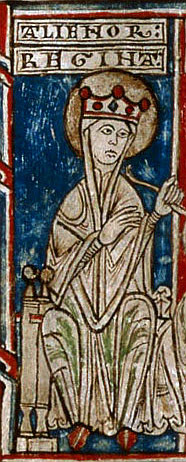
Eleanor of England (13 October 1162 - 31 October 1214) was Queen
of Castile and Toledo as wife of Alfonso VIII of Castile. She
was the sixth child and second daughter of Henry II of England
and Eleanor of Aquitaine. [baptised by Henry of Marcy]. When she
was 14 years old, before 17 September 1177, Eleanor was married
to King Alfonso VIII of Castile in Burgos.
Her daughter, Blanch (de Castile) was married on 23 May 1200
to Prince Louis of France, who succeeded his father as King Louis
VIII on 14 July 1223. Crowned Queen at Saint-Denis with her husband
on 6 August 1223. Regent of the Kingdom of France during 1226-1234
(minority of her son) and during 1248-1252 (absence of her son
on Crusade).
Her son, Ferdinand, was heir of the throne since his birth. It
was on his behalf that Diego of Acebo and the future Saint Dominic
travelled to Denmark in 1203 to secure a bride.
Critics believe that Peire d'Alvernha wrote the sirventes during
the trip that an illustrious Castilian retinue took to Bordeaux
in 1170. Alfonso VIII was to marry Eleonor of England, daughter
of Henry II of England and Eleanor of Aquitaine. We have the name
of the main Castilian ambassador to Bordeaux, Gonzalo Ruiz de
Azagra, a Navarrese who became a vassal and courtier to Alfonso
VIII. This solves the problem of the ientity of "Gonzalgo
Roitz", and links the sirventes and Peire d'Alvernha to Alfonso
VIII de Castilla: Peire wrote "Chantarai d´aqestz trobadors"
for and during Gonzalo Ruiz and Eleonor's trip to Castilla.
The festive occasion justifies the satire's cheerful and convivial
mood, as well as the presence of so many troubadours: a royal
wedding between the open handed Plantagenet clan and the powerful
king of Castille promised lavish patronage. The celebration attracted
famous troubadours such as Giraut de Bornelh, Peire d'Alvernha,
and Peire de Monzo, who probably came from the court of Alfonso
II de Aragón, since this monarch intervened decisively
in the wedding's organization. Alfonso VIII presumably rewarded
all the troubadours in attendance regardless of where they came
from, and through this generosity he laid the basis for his fame
as a munificent patron. Peire d'Alvernha and his comrades obliged
him, and thereafter celebrated Alfonso's virtues in their songs.
Peire d'Alvernha's poetry proves that he had close relations with
the Castilian court under Sancho III, and later under Alfonso
VIII himself.
|
| |
|
Eleanor of England, Queen of Castile
|
 |
|
|
| |
| |
| |
| |
|
|
| |
|
|
|
|
GUIDED TOURS OF CATHAR CASTLES OF THE LANGUEDOC
You can join small exclusive guided tours of Cathar Castles
led by an English speaking expert on the Cathars
who lives in the Languedoc
(author of www.cathar.info)
Selected Cathar Castles. Accommodation provided. Transport
Provided.
Cathar Origins, History, Beliefs.
The Crusade, The Inquisition, and Consequences
Visit
the Cathar Tours Website for more information
|
|
|
|
Photographs
|
|
|
|
|
|
|
Château de Puivert
|
 |
| |
|
Château de Puivert
|
 |
| |
|
Château de Puivert
|
 |
| |
|
Château de Puivert
|
 |
| |
|
Château de Puivert
|
 |
| |
|
Château de Puivert
|
 |
| |
|
Château de Puivert
|
 |
| |
|
Château de Puivert
|
 |
| |
|
Château de Puivert
|
 |
| |
|
Château de Puivert
|
 |
| |
|
Château de Puivert
|
 |
| |
|
Château de Puivert
|
 |
| |
|
Château de Puivert
|
 |
| |
|
Château de Puivert
|
 |
| |
|
Château de Puivert
|
 |
| |
|
Château de Puivert
|
 |
| |
|
Château de Puivert
|
 |
| |
| |
| |
|
|
Château de Puivert
|
 |
| |
|
Château de Puivert
|
 |
| |
|
Château de Puivert
|
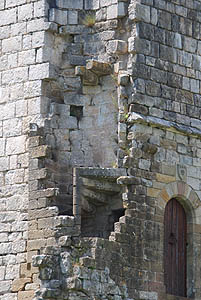
 |
| |
|
Château de Puivert
|
 |
| |
|
Château de Puivert
|
 |
| |
|
Château de Puivert
|
 |
| |
|
Château de Puivert
|
 |
| |
|
Château de Puivert
|
 |
| |
|
Château de Puivert
|
 |
| |
|
Château de Puivert
|
 |
| |
|
Château de Puivert
|
 |
| |
|
Château de Puivert
|
 |
| |
|
Château de Puivert
|
 |
| |
|
Château de Puivert
|
 |
| |
|
Château de Puivert
|
 |
| |
|
Château de Puivert
|
 |
| |
|
Château de Puivert
|
 |
| |
|
Château de Puivert
|
 |
| |
| |
|
|
Château de Puivert
|
 |
| |
|
Château de Puivert
|
 |
| |
|
Château de Puivert
|
 |
| |
|
Château de Puivert
|
 |
| |
|
Château de Puivert
|
 |
| |
|
Château de Puivert
|
 |
| |
|
Château de Puivert
|
 |
| |
|
Château de Puivert
|
 |
| |
|
Château de Puivert
|
 |
| |
|
Château de Puivert
|
 |
| |
|
Château de Puivert
|
 |
| |
|
Château de Puivert
|
 |
| |
|
Château de Puivert
|
 |
| |
|
Château de Puivert
|
 |
| |
|
Château de Puivert
|
 |
| |
|
Château de Puivert
|
 |
| |
|
Château de Puivert
|
 |
| |
|
Château de Puivert
|
 |
| |
|
|
Château de Puivert
|
 |
| |
|
Château de Puivert
|
 |
| |
|
Château de Puivert
|
 |
| |
|
Château de Puivert
|
 |
| |
|
Château de Puivert
|
 |
| |
| |
| |
| |
|
|
Château de Puivert
|
 |
| |
|
Château de Puivert
|
 |
| |
|
Château de Puivert
|
 |
| |
|
Château de Puivert
|
 |
| |
|
Château de Puivert
|
 |
| |
| |
| |
| |
|
|
|
| |
|
|
|
|
|
|
|
|
|
Château de Puivert
|
 |
| |
|
Château de Puivert
|
 |
| |
|
Château de Puivert
|
 |
| |
|
Peired'Alvernhe - BnF MS12473 fol.
|
.jpg) |
| |
| |
|
|
|


